

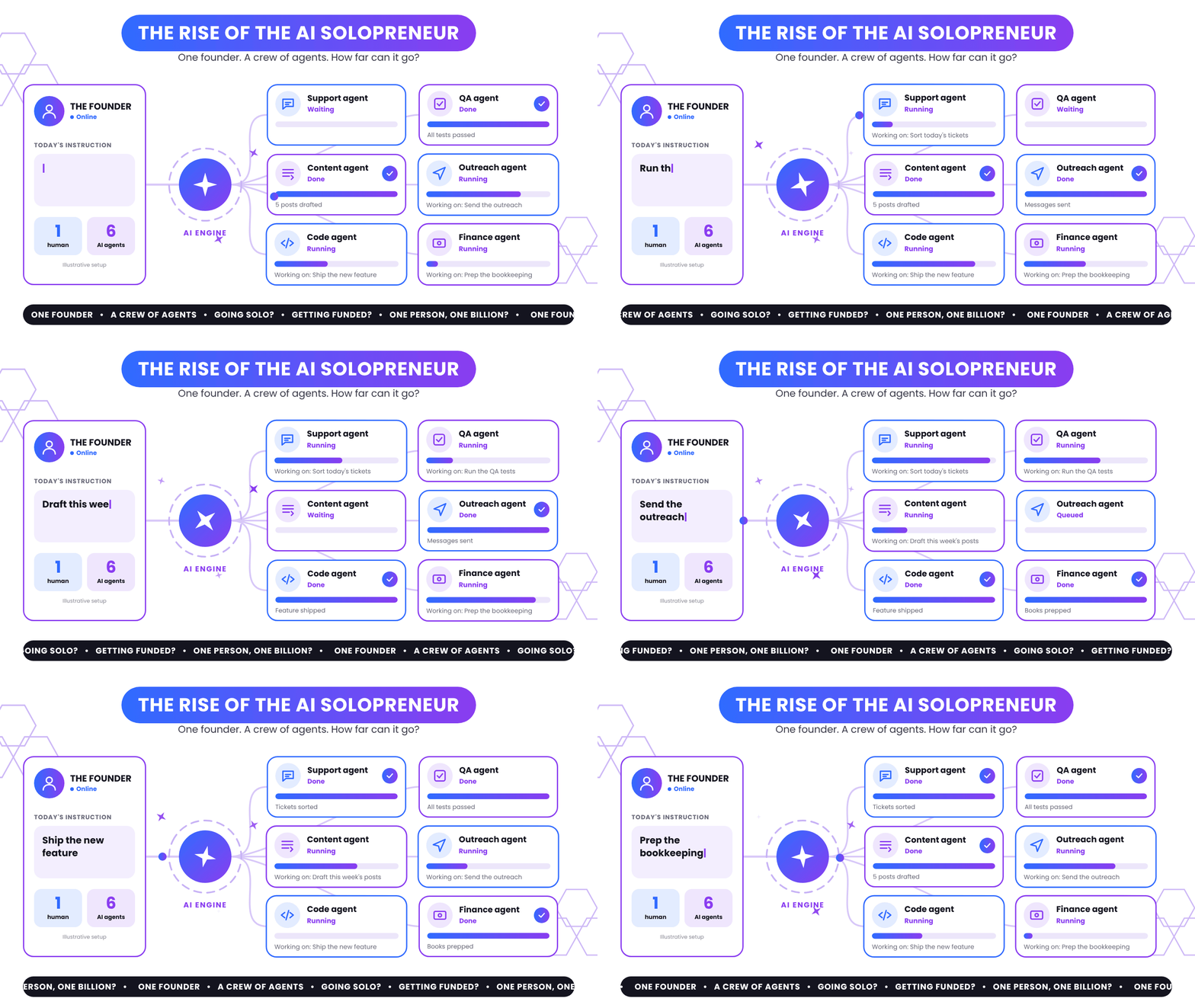
Welcome, busy bees! Somewhere right now, a founder is opening a laptop, and before the coffee is ready, one agent has sorted the support tickets, another has run the tests on yesterday’s code, and a third has drafted the week’s posts.
There is no team meeting, because there is no team. Just one person and a handful of AI agents.
It sounds almost too neat to be real, yet it is close to how the solo founders in this issue describe their days. So what is really going on here?
Here are the five questions we will work through together:
How many founders are now going solo?
Do they get funded?
What do the strongest ones do differently?
How does a one-person company actually run on AI agents?
Is a one-person billion-dollar company realistic?
One in three new startups now has a single founder
Carta tracks the share of new U.S. startups with a single founder. It has climbed steadily since 2019, with the sharpest jump in the first half of 2025, according to its Solo Founders Report. Carta’s analysts credit mostly one thing: technology has lowered the cost of starting a company.
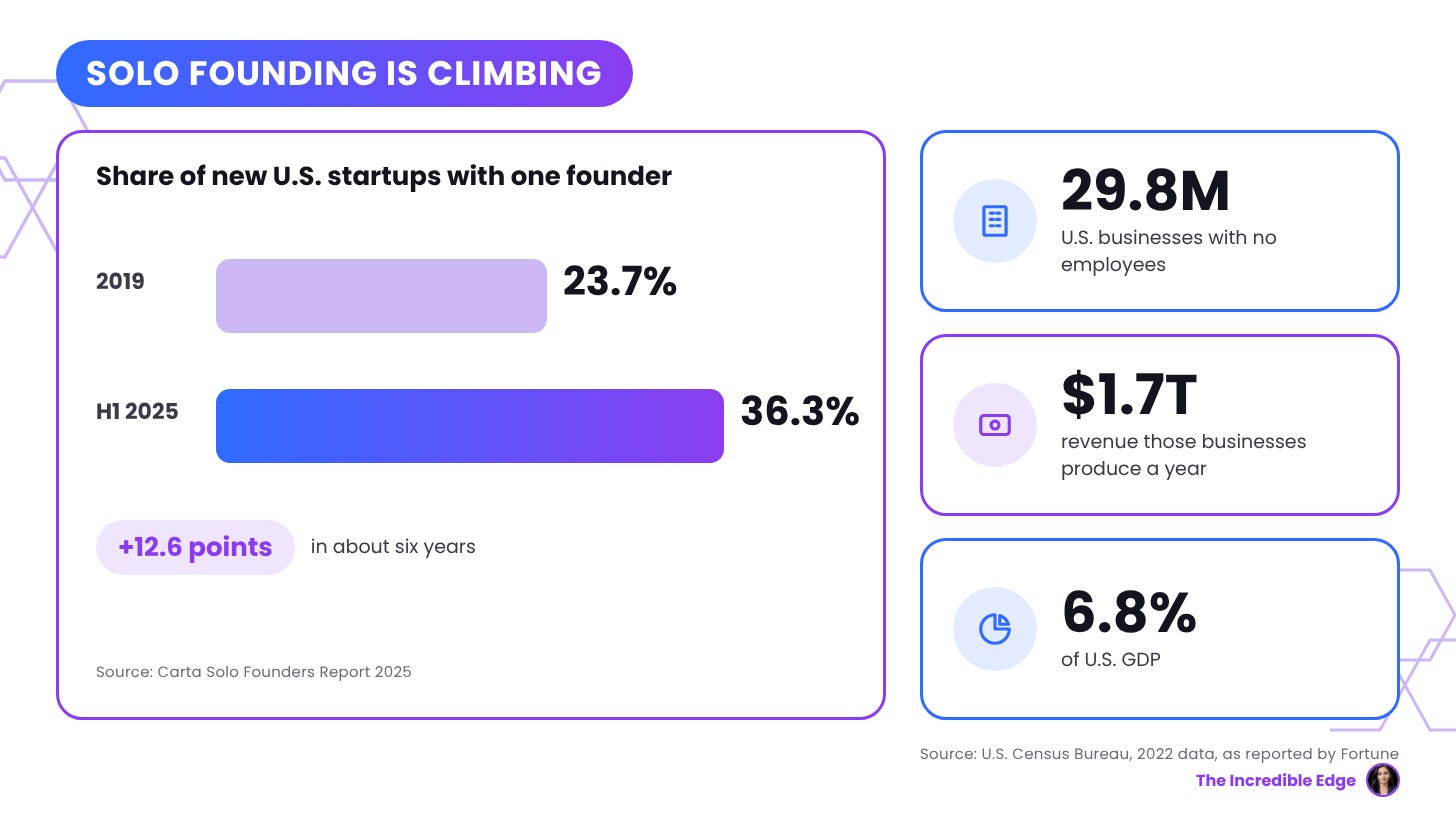
The wider solo economy is far larger than the startup slice. The Census Bureau’s count of businesses with no employees makes that clear (as reported by Fortune).
One note on the data: Carta’s figures cover companies on its platform, which skews toward startups built to raise venture money, not every solo business.
They get roughly half the venture dollars their numbers imply
Solo-led companies captured about half the share of venture cash that their share of new startups would suggest, according to the same Carta report.
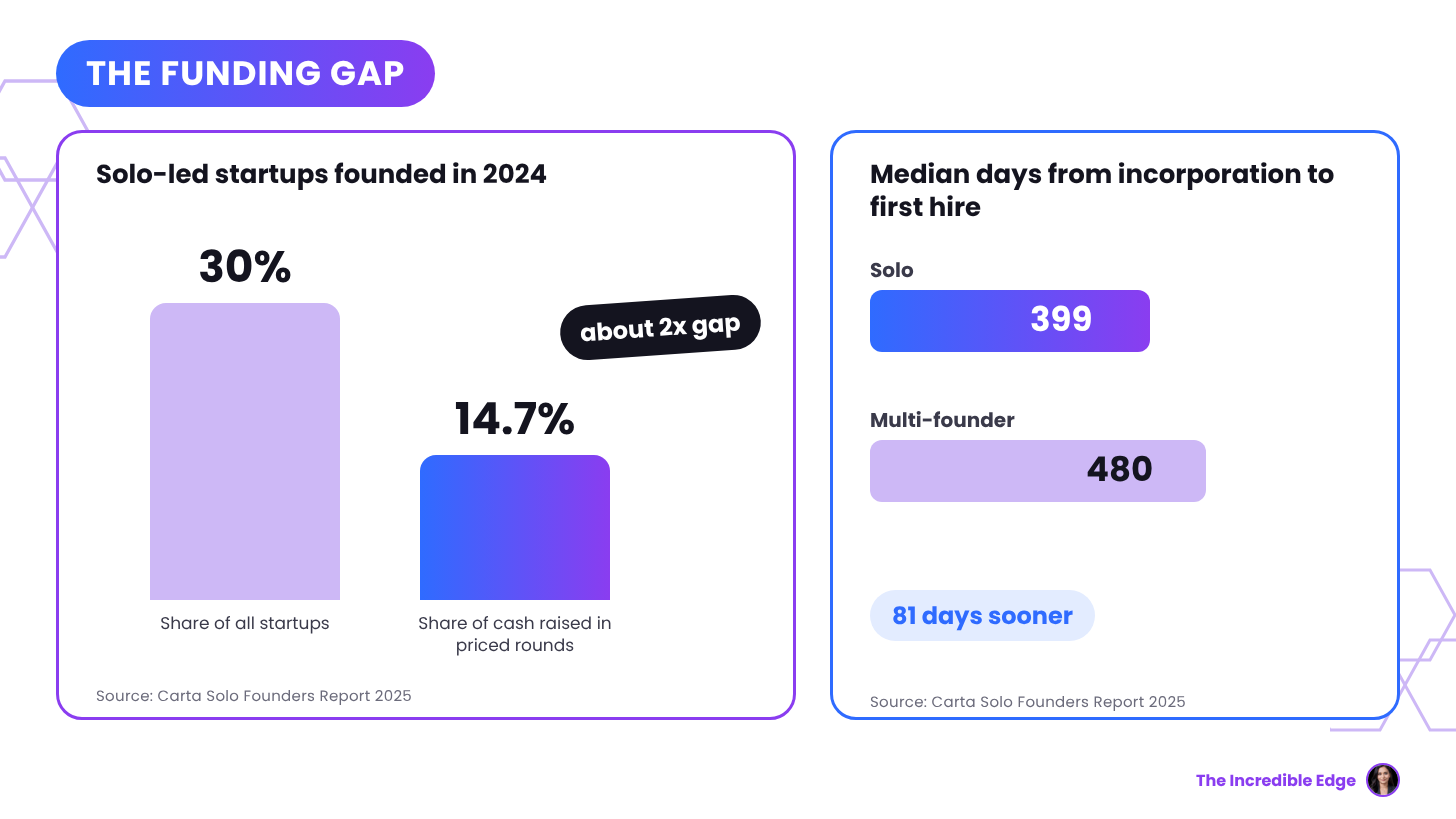
The gap does not look like a performance problem. Carta’s own analysis says solo-founded companies perform about as well as co-founded ones once they are funded. The usual investor worries are the single point of failure if the founder leaves, the load of hiring alone, and no internal sparring partner.
One detail cuts against the stereotype. Solo founders are not avoiding hiring, and they get to their first hire sooner than multi-founder teams do.
What the reported cases have in common
Look closely at the solo founders Fortune profiled in May 2026 and the same habits keep showing up.
Take Base44, the best-known case. It came out of stealth in March 2025 and, three months later, Wix agreed to buy it for $80 million upfront, with more payments due in 2029. The team was six people with no outside funding, and founder Maor Shlomo said he had put in only NIS 30,000 of his own savings (per Globes, June 2025).
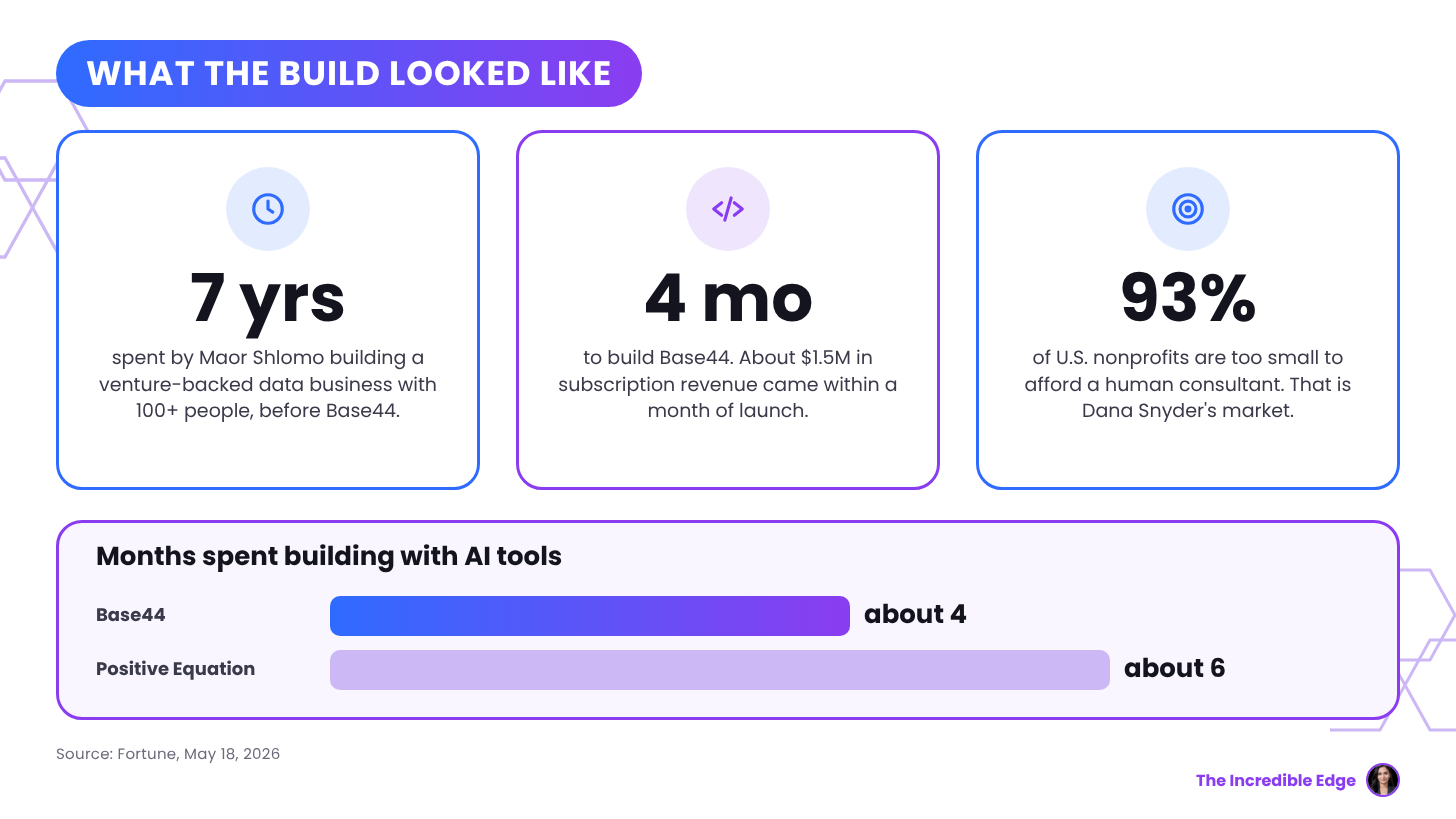
They arrive with domain depth. Maor Shlomo came from a prior venture-backed company, and Dana Snyder already ran the nonprofit consultancy Positive Equation. Both knew the problem before they touched the tools.
They pick a gap with a clear buyer. Snyder serves nonprofits too small to afford a human consultant. Base44 served nontechnical people who wanted an app from a description.
They ship fast and let revenue speak. Both built with AI tools in months, and Base44 had paying subscribers within a month of its February 2025 launch.
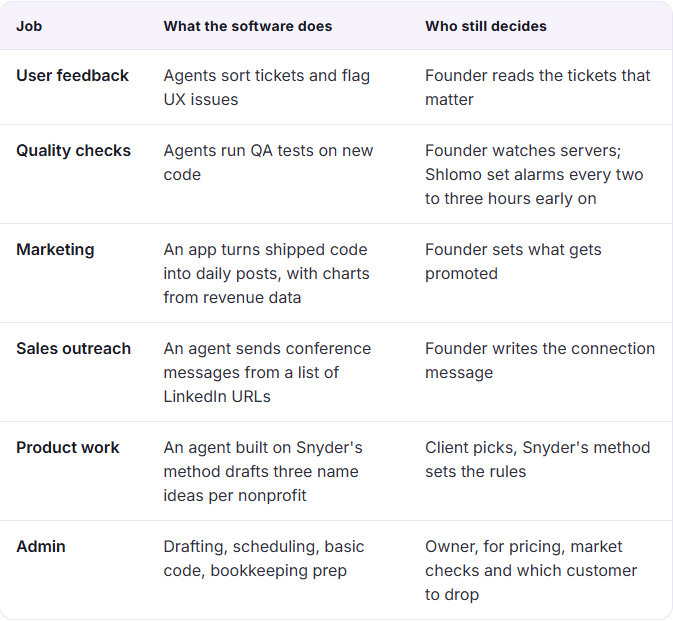
They keep the customer close. Shlomo shut down his support bot after two weeks because reading tickets himself kept him near the product.
They name their own gaps. Shlomo sold partly because scaling globally needed consumer marketing skills he lacked. In his words, “I’m a product person.”
How a one-person company runs on agents
The setups described by Fortune and Self Employed are less like a robot office and more like a set of narrow workers, each handling one repeating job.
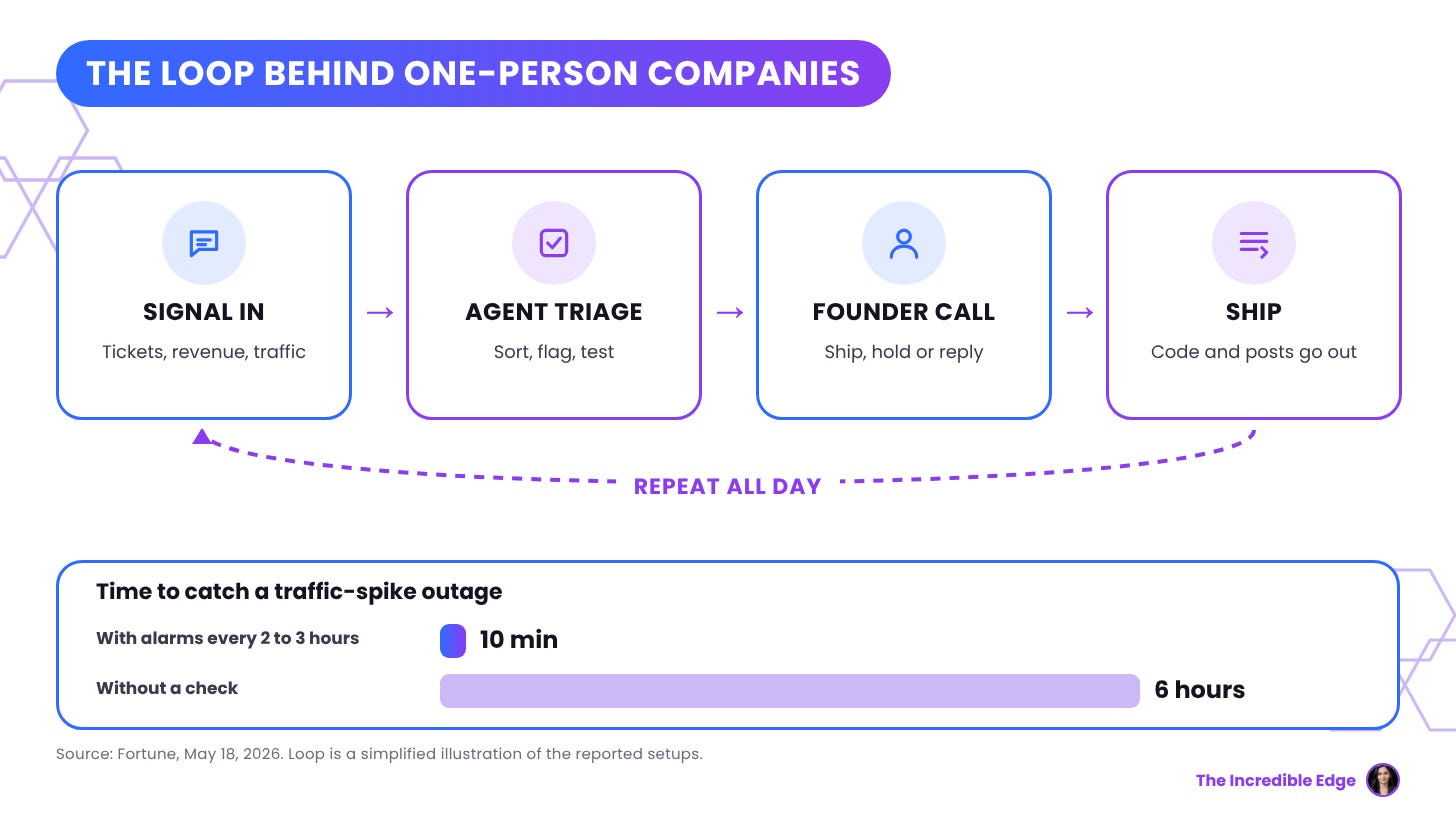
The alarm routine paid off, and the chart above shows by how much.
The costs are not zero. Fortune reports that monthly AI bills at lean startups can run to hundreds of thousands of dollars, and NYU Stern’s J.P. Eggers warns they can quickly become comparable to the salaries they replace. On quality, his caution is blunt: “You’re kind of taking it on faith that what the AI is producing is pretty good.”
A one-person billion-dollar company: not shown yet
The bet is old. Sam Altman said in 2024 that a group chat of tech CEOs had a running wager on when the first one-person billion-dollar company would appear (Fortune). At the launch of Claude 4 in May 2025, Dario Amodei was asked when the first billion-dollar company with one human employee would arrive. He answered “2026,” and gave no probability (OfficeChai, May 23, 2025).
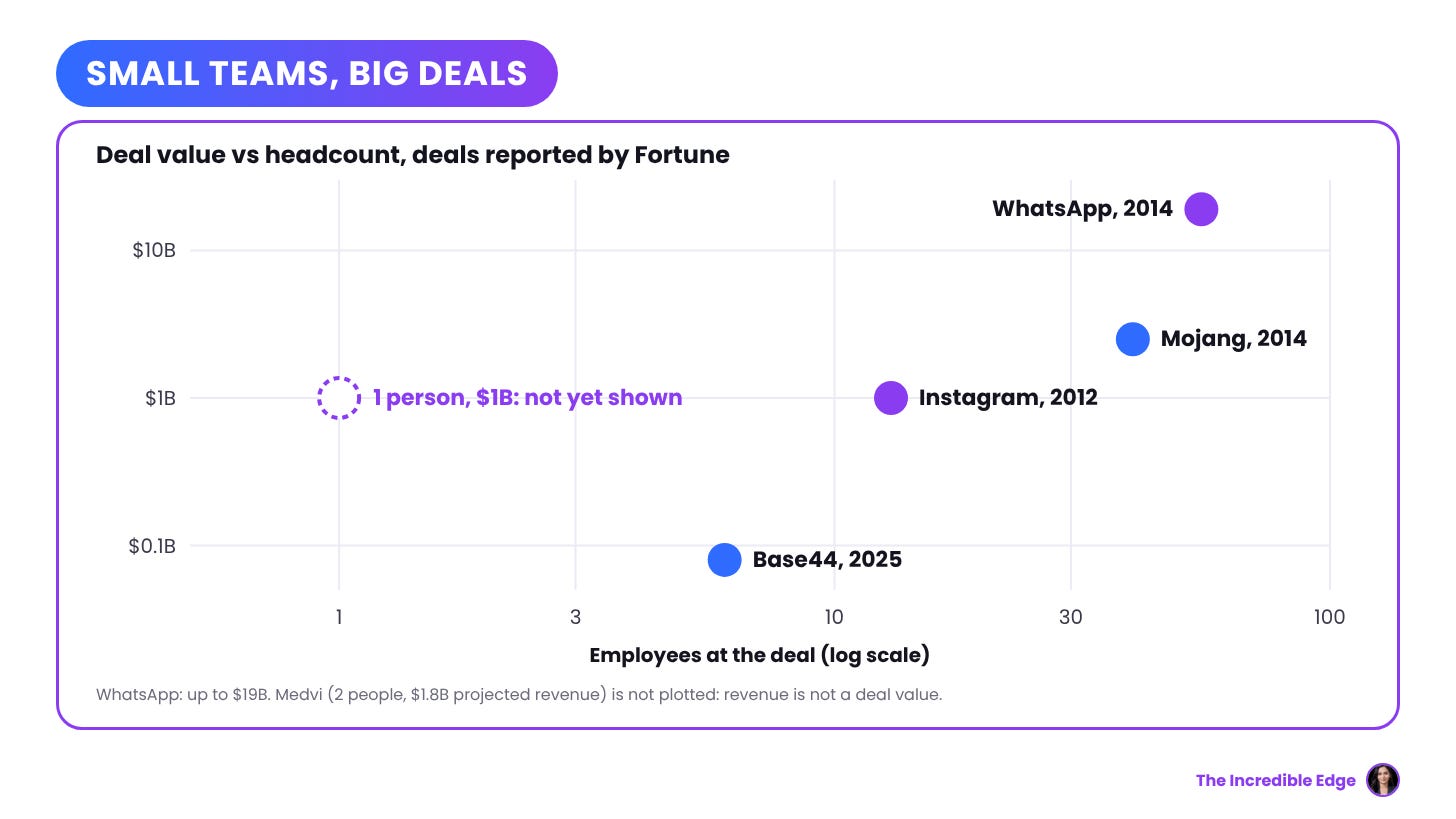
Small teams have been worth a lot before. Instagram, WhatsApp and Mojang each sold for $1 billion or more with a few dozen people or fewer (per Fortune). None had one.
The closest test so far is Medvi, a GLP-1 telehealth company. The New York Times reported $401 million in 2025 revenue and a projected $1.8 billion for 2026, with founder Matthew Gallagher and his brother as the core team. That is two people, not one, and $1.8 billion is projected revenue, not a valuation. The company has since drawn regulatory and legal scrutiny, according to later coverage.
Fortune’s sources add the practical limit. Consumer software with light regulation and no supply chain is the most viable fit. Heavy compliance, physical goods and enterprise sales still need people.
Bottom line: As of today, no company run by one human has been shown to reach a billion dollars. Tiny teams reaching large revenue is the more defensible claim.
Three checks before you go solo
Split the work. List every recurring task, mark which can run on agents, and keep the judgment calls (pricing, who to serve, who to drop) on your own list.
Pick the funding path early. If you plan to raise, expect the 2x dollar gap and walk in with a hiring plan. If you plan to skip a round, your first milestone is revenue.
Write down what you will not automate. Pick the one customer-facing job you will keep doing yourself, and keep doing it.
Enjoyed this issue?
Subscribe to The Incredible Edge for the next one on AI, careers and the systems behind both.