

Welcome, busybees
Most people using AI for job search are stuck in a loop: open a chat window, paste a job description, paste a resume, ask for a rewrite, copy the output, close the window, lose everything, and start from scratch tomorrow for the next role.
That’s not a system. That’s a treadmill.
Claude Code... Anthropic’s terminal-based agent... changes this completely.
Instead of chatting, you build a persistent, file-based job search system on your own machine: your resume, your applications, your interview prep, your research, your follow-ups, all living in one folder, versioned with git, orchestrated by Claude.
This is what engineers have quietly been doing for months. Today I’ll show you how to build it.
The complete Claude guide, with every resource we have, lives inside Incredible Edge, my daily newsletter covering hidden jobs, AI news and startup updates, completely free.
The Mental Model: Your Job Search as a Codebase
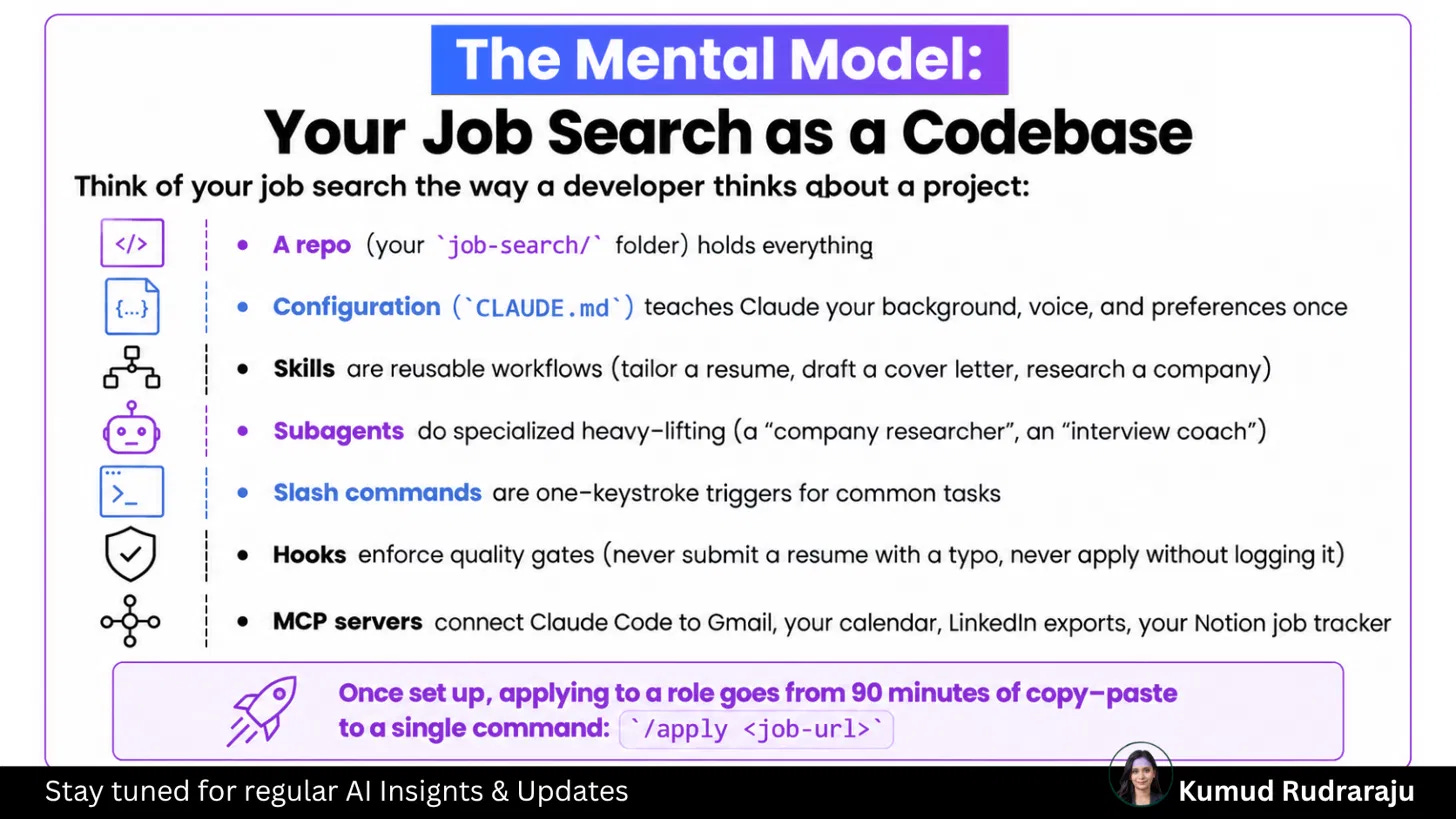
Think of your job search the way a developer thinks about a project:
A repo (your job-search/ folder) holds everything
Configuration (CLAUDE.md) teaches Claude your background, voice, and preferences, once
Skills are reusable workflows (tailor a resume, draft a cover letter, research a company)
Subagents do specialized heavy-lifting (a “company researcher,” an “interview coach”)
Slash commands are one-keystroke triggers for common tasks
Hooks enforce quality gates (never submit a resume with a typo, never apply without logging it)
MCP servers connect Claude Code to Gmail, your calendar, LinkedIn exports, your Notion job tracker
Once set up, applying to a role goes from 90 minutes of copy-paste to a single command: /apply <job-url>.
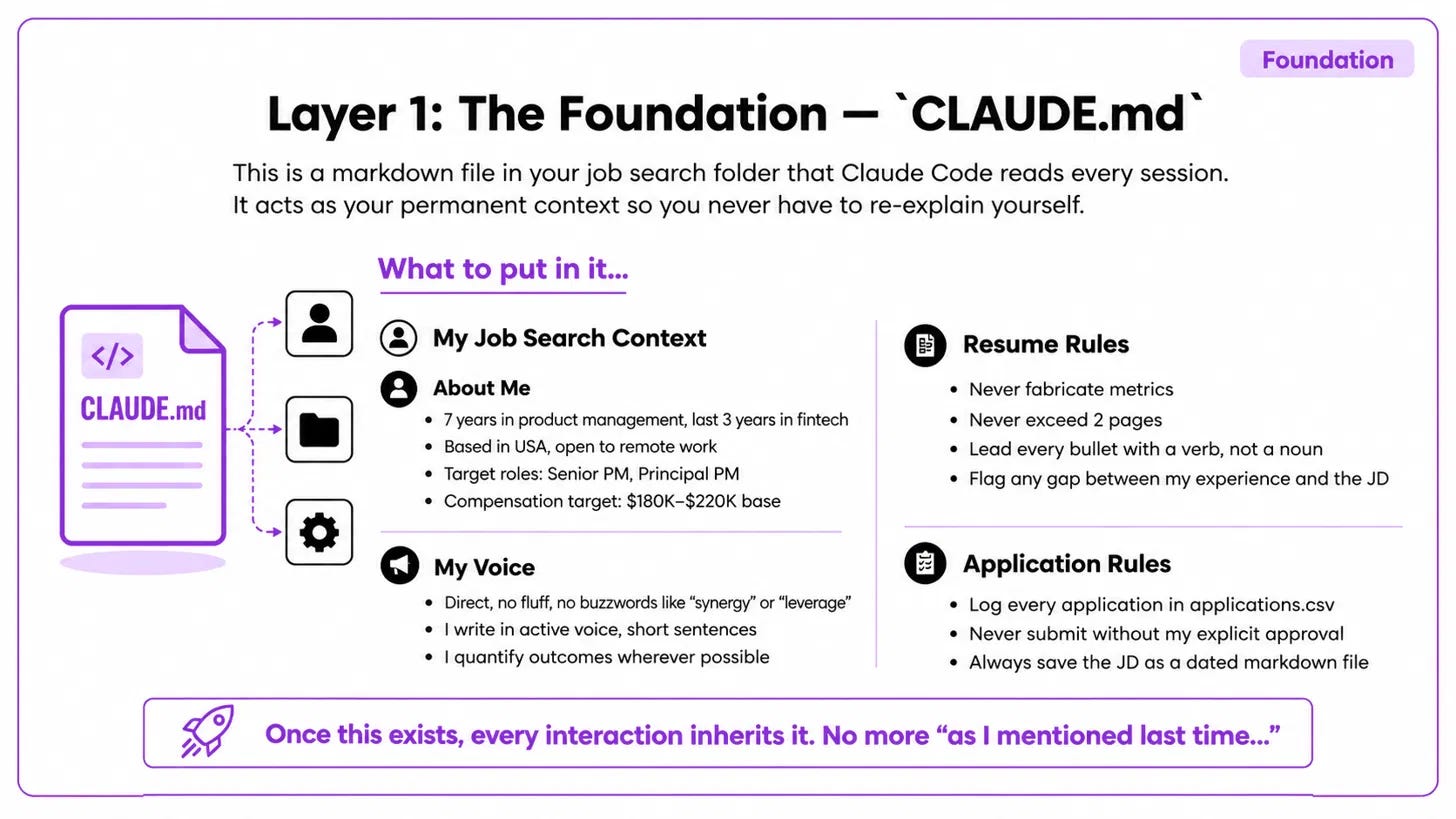
Layer 1: The Foundation, CLAUDE.md
This is a markdown file in your job search folder that Claude Code reads every session. It’s your permanent context so you never have to re-explain yourself.
What to put in it...
My Job Search Context:
About Me:
7 years in product management, last 3 years in fintech
Based in USA, open to remote work
Target roles: Senior PM, Principal PM
Compensation target: $180K–$220K base
My Voice:
Direct, no fluff, no buzzwords like “synergy” or “leverage”
I write in active voice, short sentences
I quantify outcomes wherever possible
Resume Rules:
Never fabricate metrics
Never exceed 2 pages
Lead every bullet with a verb, not a noun
Flag any gap between my experience and the JD
Application Rules:
Log every application in applications.csv
Never submit without my explicit approval
Always save the JD as a dated markdown file
Once this exists, every interaction inherits it. No more “as I mentioned last time…”
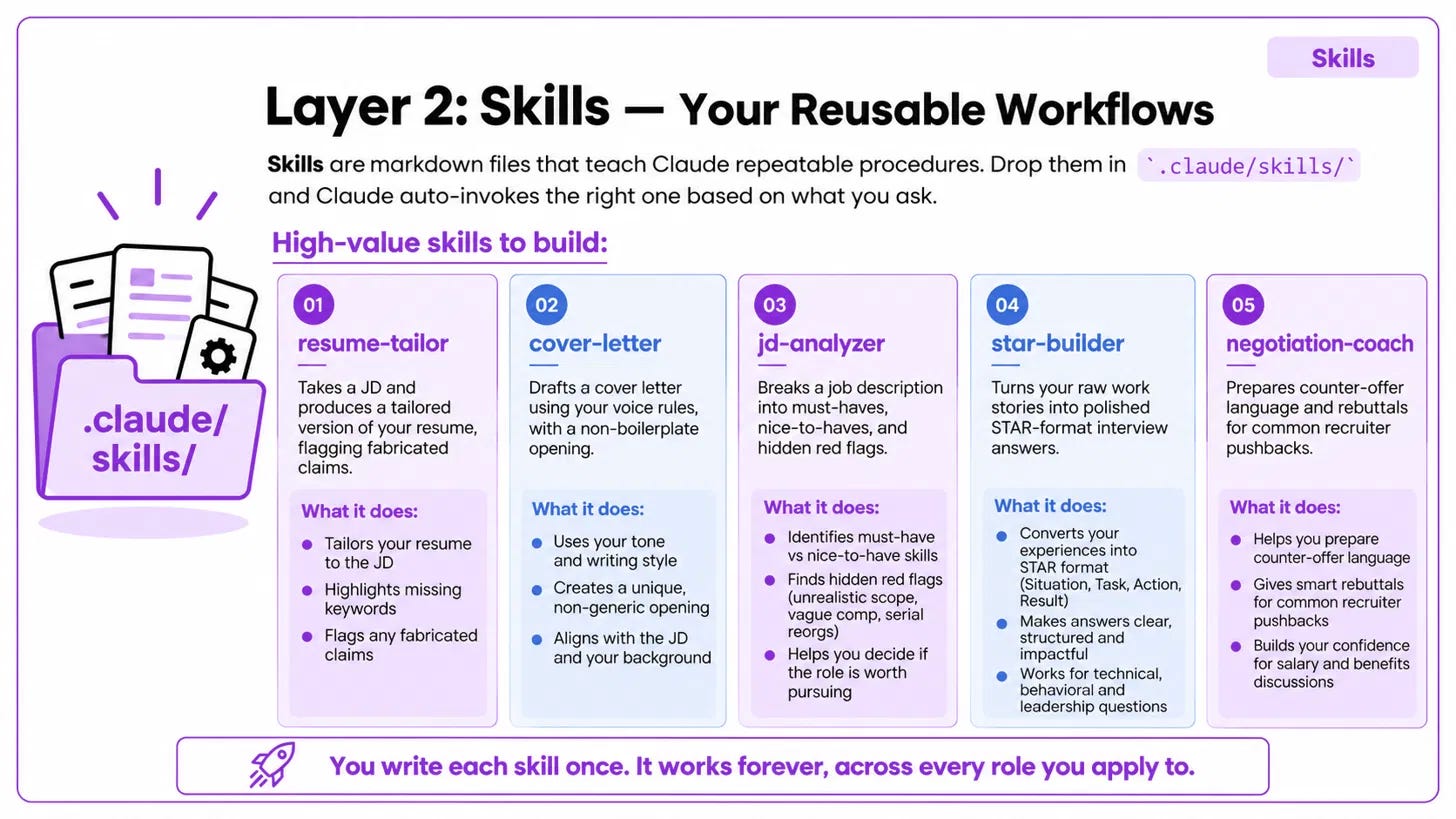
Layer 2: Skills, Your Reusable Workflows
Skills are markdown files that teach Claude repeatable procedures. Drop them in .claude/skills/ and Claude auto-invokes the right one based on what you ask.
High-value skills to build:
resume-tailor: takes a JD and produces a tailored version of your resume, flagging fabricated claims
cover-letter: drafts a cover letter using your voice rules, with a non-boilerplate opening
jd-analyzer: breaks a job description into must-haves, nice-to-haves, and hidden red flags (unrealistic scope, vague comp, serial reorgs)
star-builder: turns your raw work stories into polished STAR-format interview answers
negotiation-coach: prepares counter-offer language and rebuttals for common recruiter pushbacks
You write each skill once. It works forever, across every role you apply to.
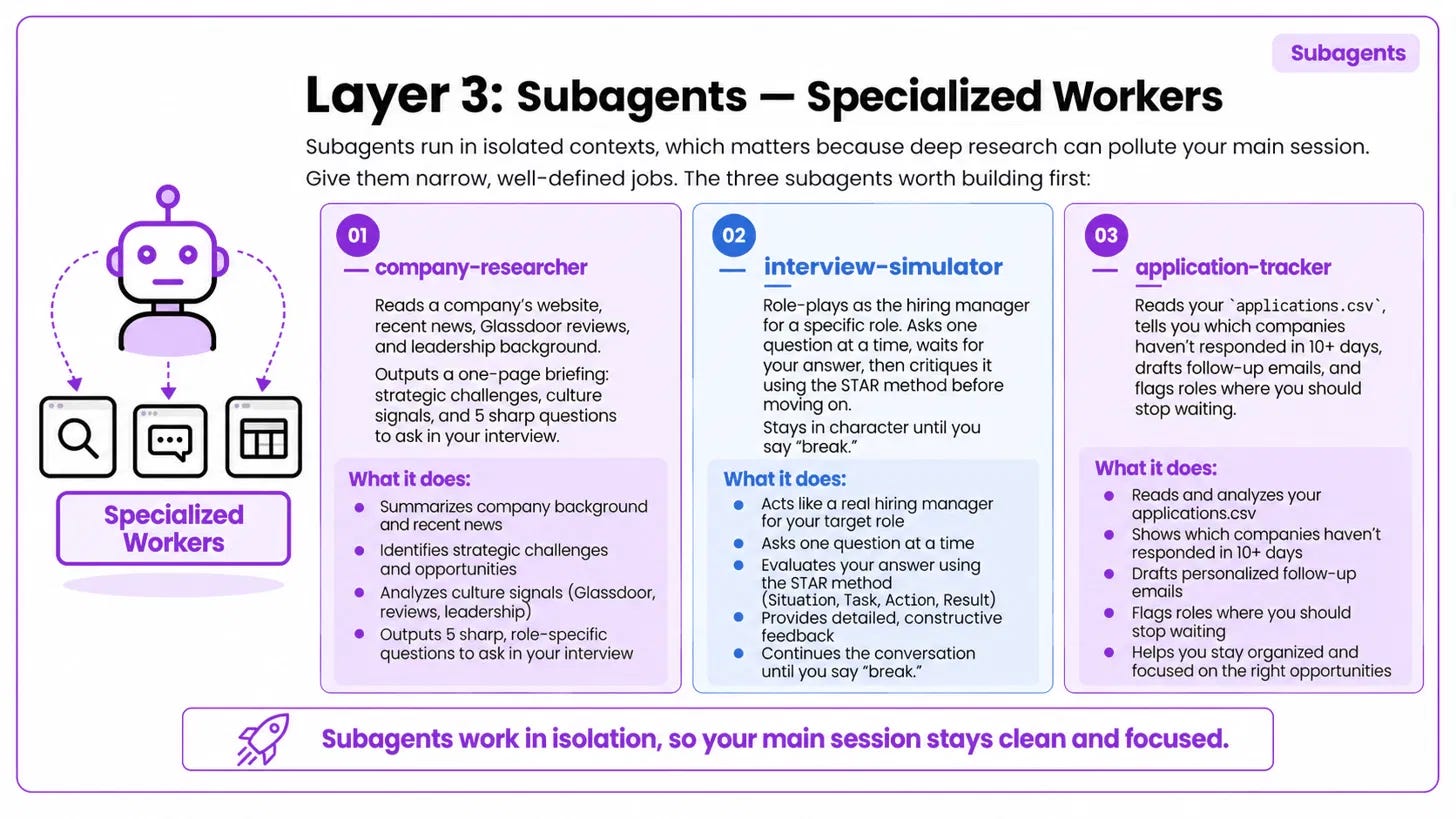
Layer 3: Subagents, Specialized Workers
Subagents run in isolated contexts, which matters because deep research can pollute your main session. Give them narrow, well-defined jobs.
The three subagents worth building first:
company-researcher Reads a company’s website, recent news, Glassdoor reviews, and leadership background. Outputs a one-page briefing: strategic challenges, culture signals, and 5 sharp questions to ask in your interview.
interview-simulator Role-plays as the hiring manager for a specific role. Asks one question at a time, waits for your answer, then critiques it using the STAR method before moving on. Stays in character until you say “break.”
application-tracker Reads your applications.csv, tells you which companies haven’t responded in 10+ days, drafts follow-up emails, and flags roles where you should stop waiting.
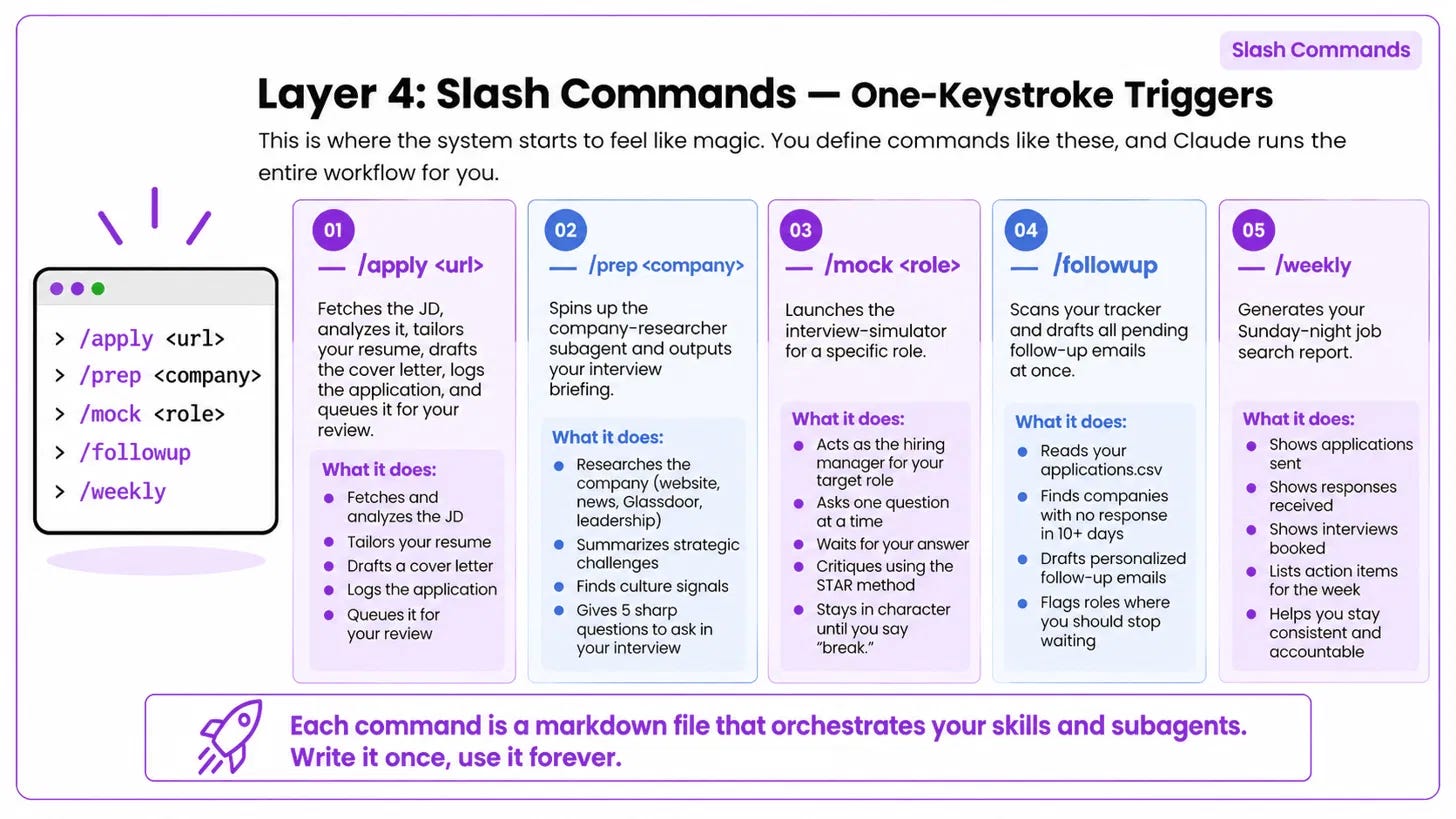
Layer 4: Slash Commands, One-Keystroke Triggers
This is where the system starts to feel like magic. You define commands like:
/apply <url>: fetches the JD, analyzes it, tailors your resume, drafts the cover letter, logs the application, and queues it for your review
/prep <company>: spins up the company-researcher subagent and outputs your interview briefing
/mock <role>: launches the interview-simulator for a specific role
/followup: scans your tracker and drafts all pending follow-up emails at once
/weekly: generates your Sunday-night job search report: applications sent, responses received, interviews booked, action items for the week
Each command is a markdown file that orchestrates your skills and subagents. Write it once, use it forever.
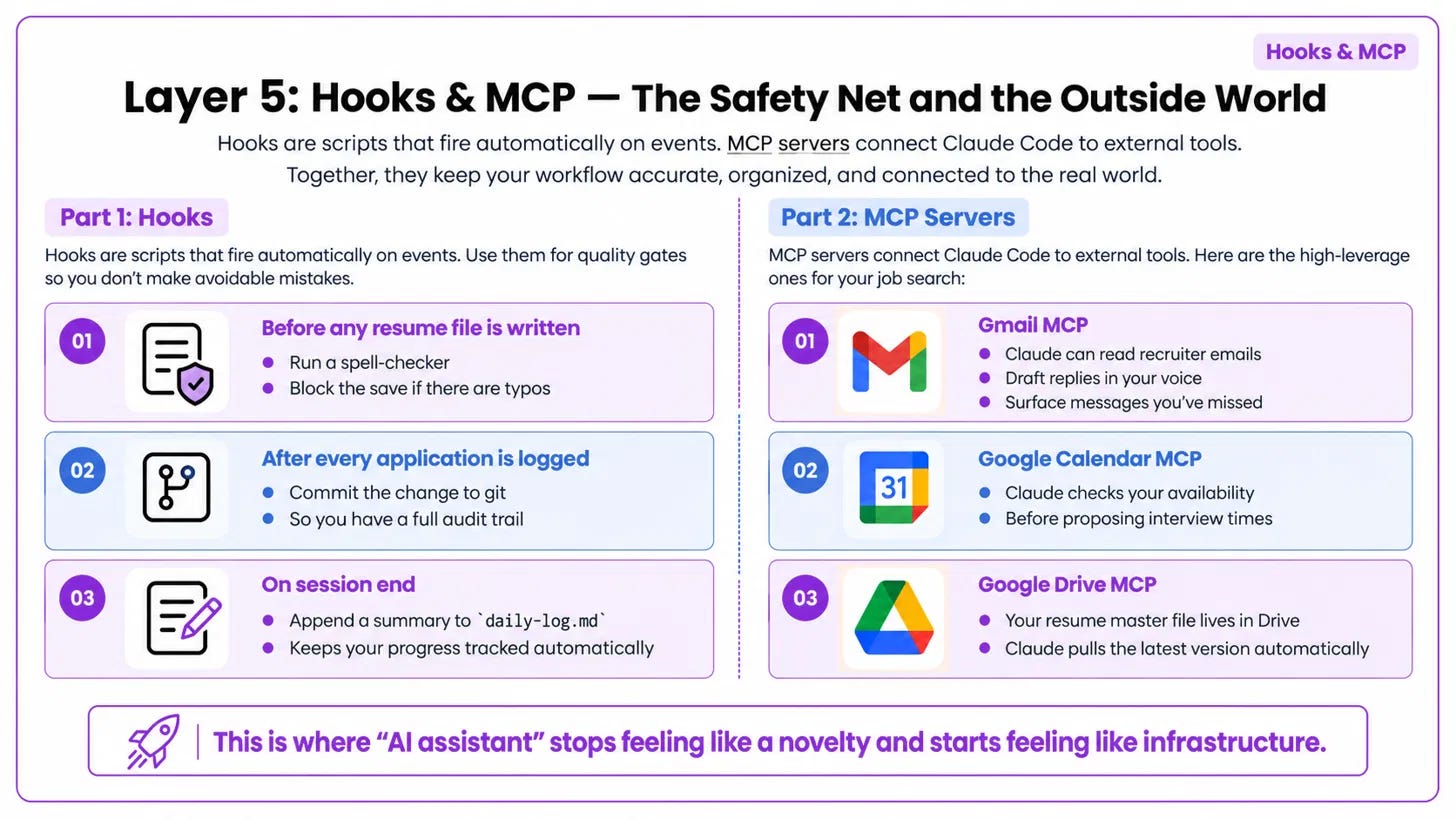
Layer 5: Hooks & MCP, The Safety Net and the Outside World
Hooks are scripts that fire automatically on events. Use them for quality gates:
Before any resume file is written → run a spell-checker, block the save if there are typos
After every application is logged → commit the change to git, so you have a full audit trail
On session end → append a summary to daily-log.md
MCP servers connect Claude Code to external tools. The high-leverage ones for job search:
Gmail MCP → Claude can read recruiter emails, draft replies in your voice, and surface messages you’ve missed
Google Calendar MCP → Claude checks your availability before proposing interview times
Google Drive MCP → Your resume master file lives in Drive; Claude pulls the latest version automatically
This is where “AI assistant” stops feeling like a novelty and starts feeling like infrastructure.
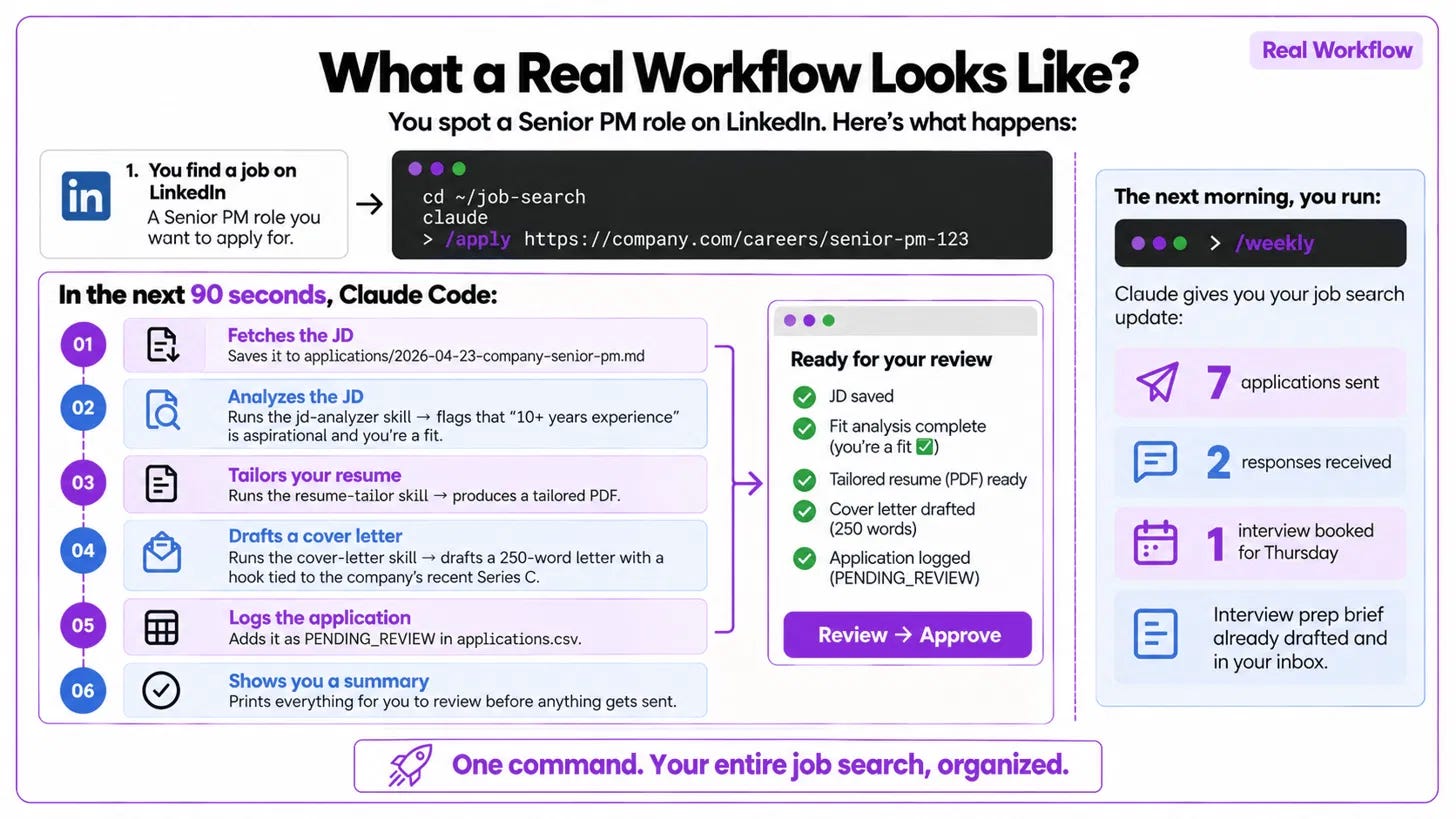
What a Real Workflow Looks Like?
You see a Senior PM role posted on LinkedIn. Here’s what happens:
cd ~/job-search
claude
> /apply https://company.com/careers/senior-pm-123In the next 90 seconds, Claude Code:
Fetches the JD and saves it to applications/2026-04-23-company-senior-pm.md
Runs the jd-analyzer skill → flags that “10+ years experience” is aspirational and you’re a fit
Runs the resume-tailor skill → produces a tailored PDF in the application folder
Runs the cover-letter skill → drafts a 250-word letter with a hook tied to the company’s recent Series C
Logs the application as PENDING_REVIEW in applications.csv
Prints a summary for you to review before anything gets sent
You read it, make two edits, approve, and move on with your life.
The next morning, you run /weekly and see: 7 applications sent, 2 responses, 1 interview booked for Thursday. Claude has already drafted the prep brief for that interview and put it in your inbox.
That’s the operating system
Want the complete Claude guide, with every resource we have?
It lives inside The Incredible Edge, my newsletter on AI, hidden jobs and career growth. Detailed guides, ready-to-copy templates and step-by-step setups, completely free.